
AROMEA Odoo Case Study: One ERP for E-Liquid Manufacturing, eCommerce and Accounting
AROMEA is a brand of GD France, a French manufacturer of e-liquids, nicotine boosters, and bases. It caters to individuals, resellers, and private label clients (MDD). Production is carried out in-house on several filling machines. Sales occur through two distinct sites, B2C and B2B.
Before the project, each activity relied on its own tool. There were two PrestaShop sites and production tracking on a spreadsheet. Accounting operated by sending documents to an external firm. The AROMEA Odoo project aimed to consolidate these flows into a single system.
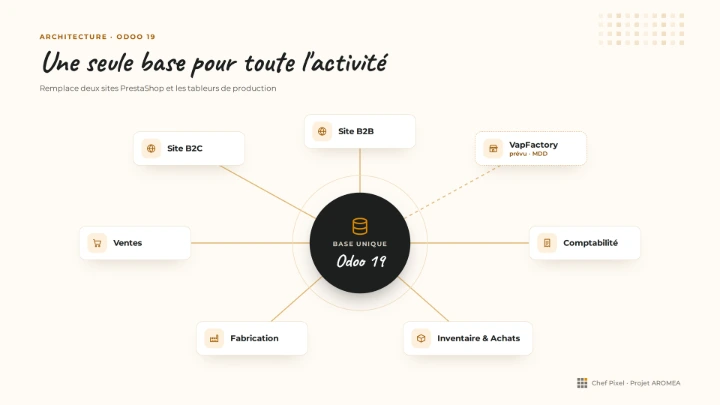
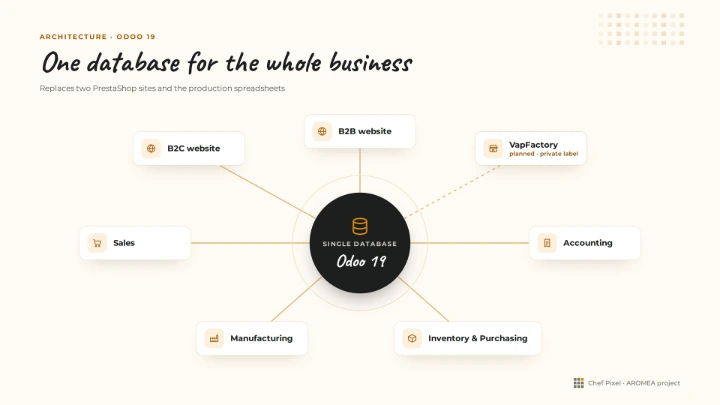
In short : AROMEA brings together on Odoo 19 its B2B and B2C sites, its machine-organized manufacturing, its stock tracked by batch, and its accounting, in a single database.

1. Understand AROMEA's business needs
The working sessions highlighted several difficulties.
- Manual production tracking. The production manager recorded consumption in his spreadsheets. He manually deducted stock and counted packaging each week.
- A vast and multi-level catalog. Nearly a thousand bill of materials, multiplied by nicotine levels, sizes, and packaging (unit, box of 10, bag of 100).
- Limited financial visibility. The figures were only consolidated at the balance sheet. Better managing the activity was one of the main reasons for choosing Odoo.
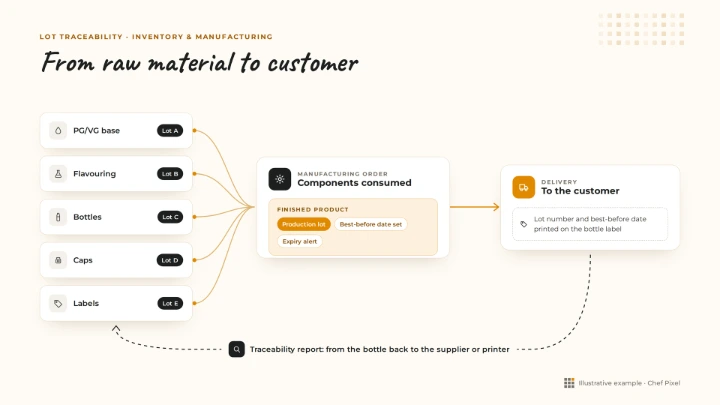
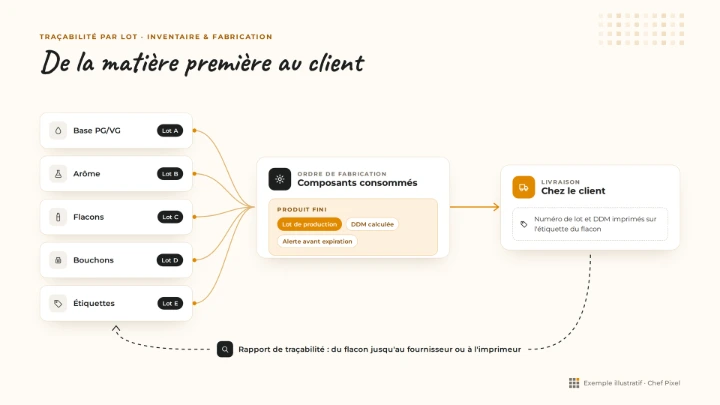
- Traceability. Raw materials, bottles, caps, and printed labels had to be tracked by batch, up to the supplier or printer.
- Business continuity. A replacement for the production manager had to find everything in the manufacturing order.
2. The ERP solution Odoo
The AROMEA ERP is based on Odoo 19. It connects several applications in a single back-office:
- Website and eCommerce: the B2B and B2C sites replace PrestaShop. A third site, VapFactory, is planned for private label customers.
- Ventes : les commandes web arrivent directement dans Odoo. La carte bancaire les confirme automatiquement, et les virements sont validés manuellement.
- Fabrication : nomenclatures, ordres de fabrication et postes de travail représentant les machines de remplissage.
- Inventaire et achats : réceptions suivies par lot, dates d'expiration, règles de réapprovisionnement, bons de livraison et opérations par code-barres.
- Accounting: supplier invoices, electronic billing, and declarations, which it is recommended to keep in the same database.
~1,000
bills of materials to structure
3
websites on a single Odoo database (B2B, B2C, VapFactory planned)
208 min
of machine time calculated for 2,500 units
1
back-office for sales, production, inventory, and accounting
3. Main customizations and Odoo development
Bills of materials adapted to volume
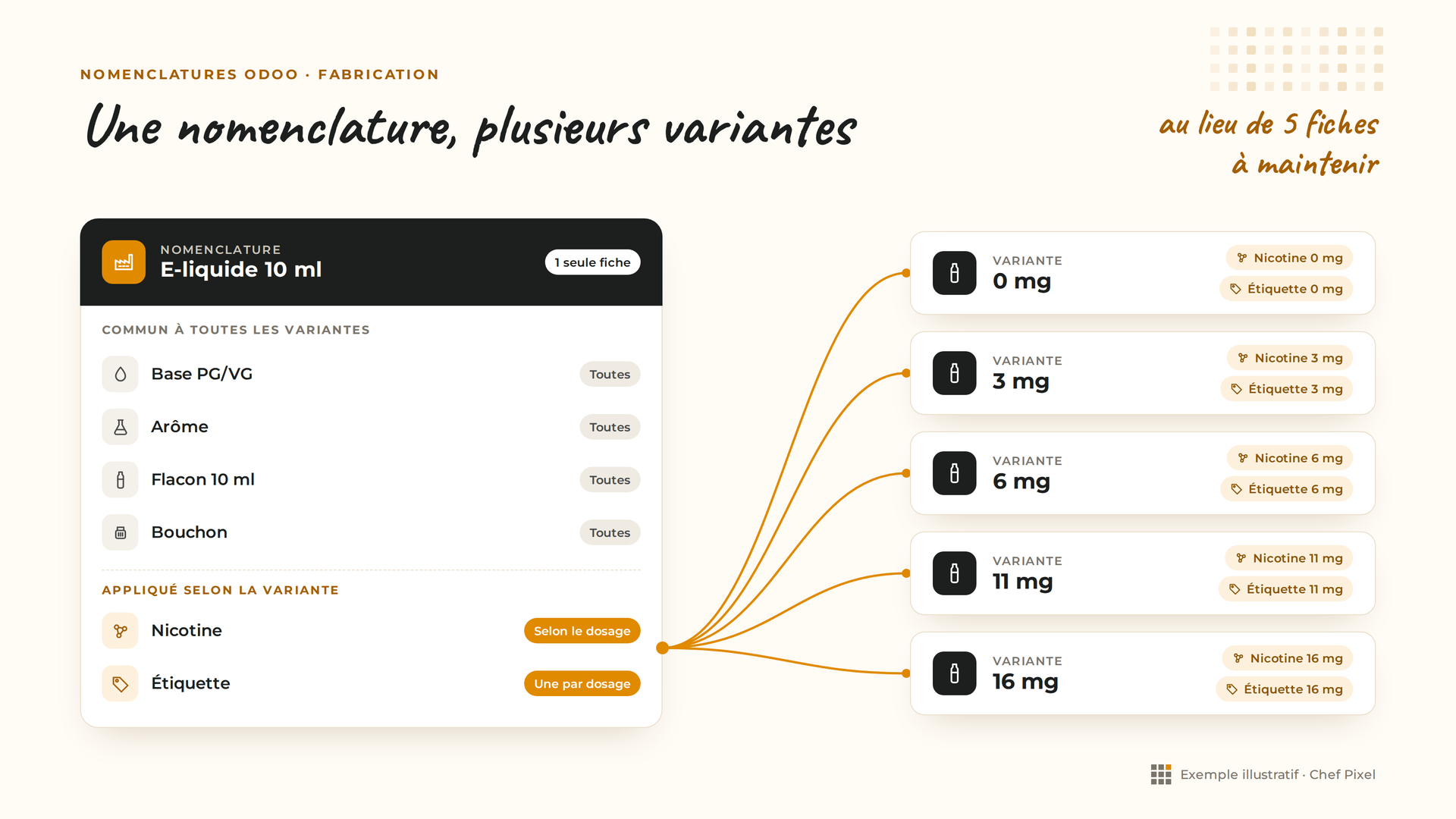
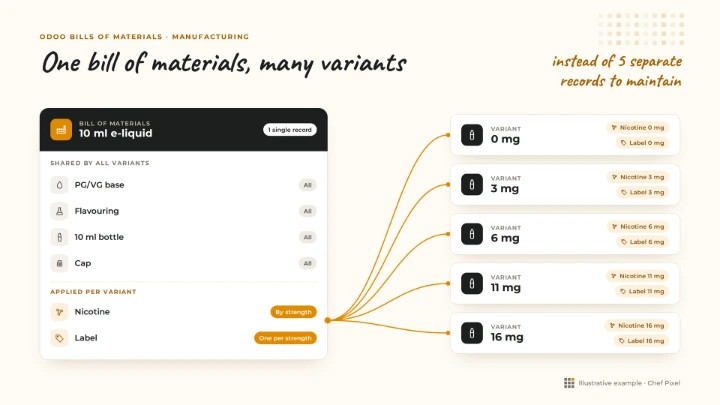
A bill of materials per variant would have been unmanageable. The team opted for a bill of materials per product, some lines of which only apply to specific variants, such as nicotine or the label for each dosage. Simple assemblies, like a box of 10 boosters, are kits managed by logistics; true recipes trigger manufacturing orders.
Bulk import of bills of materials
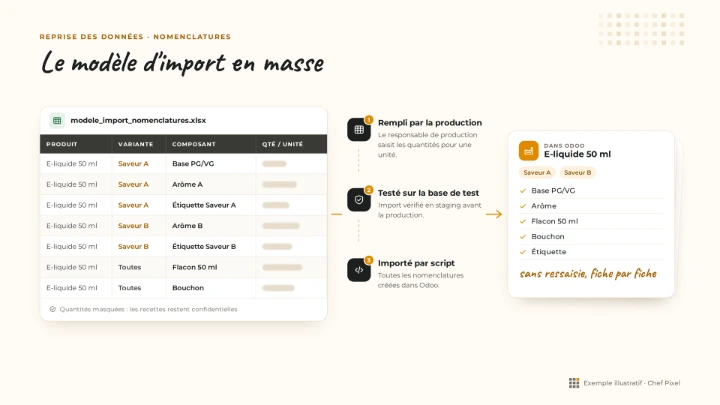
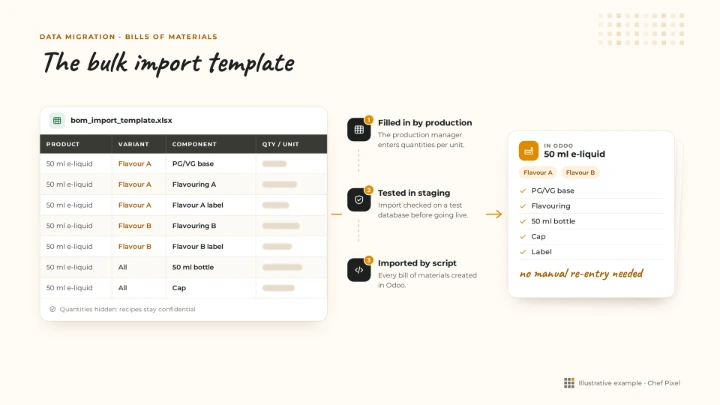
Rather than re-entering everything, the team designed an import template listing the attributes and identifiers of each product. The production manager indicates the unit quantities, and then scripts import them after validation on a test database.
Made to order and in stock
A web order for a product that is out of stock automatically creates a manufacturing order. For stocked items, minimum/maximum replenishment rules generate manufacturing orders instead of purchase orders, either manually or automatically.
Traceability of batches and expiration dates
Each production receives a batch number and a validity period, with a withdrawal date and early alert. The traceability report indicates the batches of raw materials used. The batch format has been customized, and a label printing script retrieves the batch number as well as the DDM.
Machine scheduling
Workstations use times calculated by machine and product type: 2,500 units represent approximately 208 minutes, for example. Saved filters group productions by bottle format, such as 10 ml, to schedule them consecutively. A production can only start when all components are available.
Workshop documents
The production sheet includes an operator and signature area while remaining close to the standard, so that future updates remain affordable.
Odoo integration for accounting
Rather than adding a separate tool, the recommended organization keeps accounting in Odoo:
- supplier invoices are sent by email and read by OCR and AI;
- the accountant has the FEC exports ;
- electronic invoicing goes through the approved Odoo platform ;
- VAT is transmitted by EDI, and Intrastat covers the DEB.
- The multi-company manages related structures, and access rights isolate accounting.
Features that set us apart
 Web order
Placed on the B2B or B2C site; the credit card confirms it automatically.
 Manufacturing order
Created automatically when the product is out of stock.
 Batch and production
Consumed components, generated batch, recorded traceability.
 Delivery
The delivery note becomes available for logistics.
4. Improve operations
The customized Odoo solution changes daily life :
- Less manual entries : stock is consumed automatically upon production registration.
- Une information centralisée : la commande web, l'ordre de fabrication, les numéros de lot et la livraison sont reliés.
- Homogeneous processes : the manufacturing order lists components, labels to print, and operations.
- Controlled flexibility : consumption can deviate from the recipe with a warning.
- Better visibility : statuses, filters, and dashboards show what is pending, ready, or completed.
5. Why Odoo was suitable for managing AROMEA
AROMEA needed eCommerce, manufacturing, inventory, and accounting to share the same data. Odoo's modular architecture brings these areas together in a single database.
Kits, lines by variant and replenishment rules cover the essentials through simple configuration. Specific development is reserved for batches, labels, imports, and documents. The planned addition of a third site without changing platforms demonstrates the scalability of the solution.
6. Results and impact
Résultats documentés pendant le projet :
- Imported B2B catalog; B2B and B2C products unified with variants by channel.
- Demonstrated complete flows: web order → manufacturing order → delivery, and replenishment rule → production.
- Traceability reports displaying the batches of raw materials for each production.
- The production manager finds Odoo well-suited for daily tracking.
- A clear accounting organization, without duplicate tools.
Expected benefits once in production
Fewer double entries, faster financial visibility, and the calculation of the cost price as soon as the purchase costs and machine hourly rates are entered. No quantified gain has been measured at this stage.
[Validated quote from the production manager of AROMEA on daily tracking in Odoo]
Conclusion
Le projet AROMEA Odoo montre qu'une personnalisation ERP est plus efficace lorsqu'elle part des contraintes réelles du métier. Ici, il s'agissait d'un catalogue riche en variantes, d'une traçabilité par lot et d'une production organisée par machine. En combinant le standard Odoo et des développements ciblés, AROMEA dispose d'un socle unique pour ses sites, sa production et ses finances.
An Odoo project in sight?
Our team will be happy to discuss your processes.